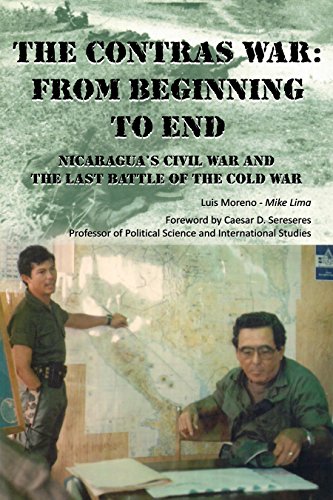
Written via Luis Moreno (known as "Mike Lima" in this decade lengthy clash) the writer examines in his e-book Principio Y Fin de los angeles Guerra de los Contras (The Contras warfare: From starting to finish) the armed fight and the method that could have fee the lives of greater than 6,000 Contra combatants and a complete of a few 15,000 anti-Sandinista supporters and kin out and in of Nicaragua. The armed clash happened among the Nicaraguan Resistance (the Contras) and the Sandinista safeguard forces (over 100,000) who helped govern Nicaragua within the 1980's.
Moreno presents an within point of view of the way within which the Contras built as a small strength of under a thousand within the early 1980's to over 20,000 that might demobilize after the Violeta Chamorro election of early 1990.
A major learn through Moreno that are supposed to be learn besides these books by means of Stephen Kinzer--Blood of Brothers, Christopher Dickey--With the Contras, Glenn Garvin--Everybody Had His Gringo, Sam Dillion--Commandos, Timothy Brown--The genuine Contra warfare, and different courses that search to give an explanation for the Nicaraguan Resistance and the level it used to be obvious as a failure or successful within the politics of the Nicaraguan kingdom and usa international policy.
What makes this learn vital and detailed is that Moreno presents a close perception into the production of the Resistance by way of folding jointly significant forces: the Milpas (anti-Sandinista farmers and peasants), former Sandinista insurgents and remnants of Somoza's military and EBBI--survivors of the 1979 struggle opposed to the Sandinista insurgents. As either a box commander inside of Nicaragua and a member of the Strategic Command after tragically wasting a part of his correct hand and arm in a coaching coincidence Moreno is ready to speak about Resistance personalities, pondering in the Resistance, and the selections that the Resistance confronted. additionally,
Moreno, the Resistance "Operations Director" within the Strategic Command discusses the tactic, plans, and institutional kinfolk of the Resistance--especially with the Hondurans and the Americans.
Why learn this booklet? The specified photo of the Nicaraguan rural components of clash; how an rebel stream is geared up; the significance of the agricultural inhabitants help to the Resistance.
Caesar D. Sereseres
Professor of Political technological know-how and overseas Studies
School of Social Sciences
University of California, Irvine