By Henry John Walker
By Megha Kumar
By Swami Venkatesananda
This is Swami Venkatesananda's longer Yoga Vasistha. His quantity booklet is the following provided among covers. Its objective is to supply a method to put off mental conditioning and to realize liberation. Containing the directions of the sage Vasistha to Lord Rama, this scripture is filled with intricately woven stories, the sort a good instructor may perhaps inform to carry the curiosity of a student.
By Kisor Kumar Chakrabarti
By John Zavos,Pralay Kanungo,Deepa S Reddy,Maya Warrier,Raymond Brady Williams
The essays during this quantity are divided into topics that handle various points of the strategies that shape glossy Hinduism. The ebook contains discussions on issues equivalent to ecumenical projects, the modern interpretation of specific sampradaya and guru traditions, modes of neighborhood mobilisation and the mediation innovations of other teams. It additionally offers India and diaspora-focused case reports in addition to 'Snapshot' perspectives elaborating on diverse themes.
Taking a severe method of the assumption of Hinduism and how it turns into public, the ebook offers an attractive learn on modern Hinduism.
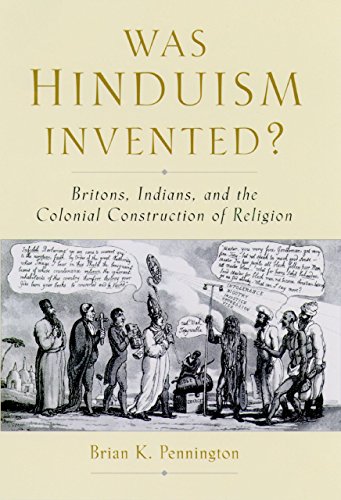
By Brian K. Pennington
By Joyce Burkhalter Flueckiger
By Edwin Bryant
By Meera Nanda
Conventional knowledge says that integration into the worldwide marketplace
has a tendency to weaken the facility of conventional religion in developing
nations. yet, as Meera Nanda argues during this path-breaking book,
this can be infrequently the case in today’s India. opposed to expectancies of
transforming into secularism, India has as an alternative noticeable a extraordinary intertwining
of Hinduism and neoliberal ideology, spurred on through a growing
capitalist classification. it truly is this “State-Temple-Corporate Complex,”
she claims, that now wields decisive political and fiscal power,
and gives ideological conceal for the dismantling of the Nehru-era
state-dominated economy.
According to this new good judgment, India’s swift financial progress is attributable
to a unique “Hindu mind,” and it's what separates the
nation’s Hindu inhabitants from Muslims and others deemed to be
“anti-modern.” for that reason, Hindu associations are exchanging public
ones, and the Hindu “revival” itself has turn into tremendous enterprise, a major
resource of capital accumulation. Nanda explores the roots of this
improvement and its attainable destiny, in addition to the fight for secularism
and socialism within the world’s second-most populous country.
By John Stratton Hawley